

Analysis
The injected code tried to add an SSH key.
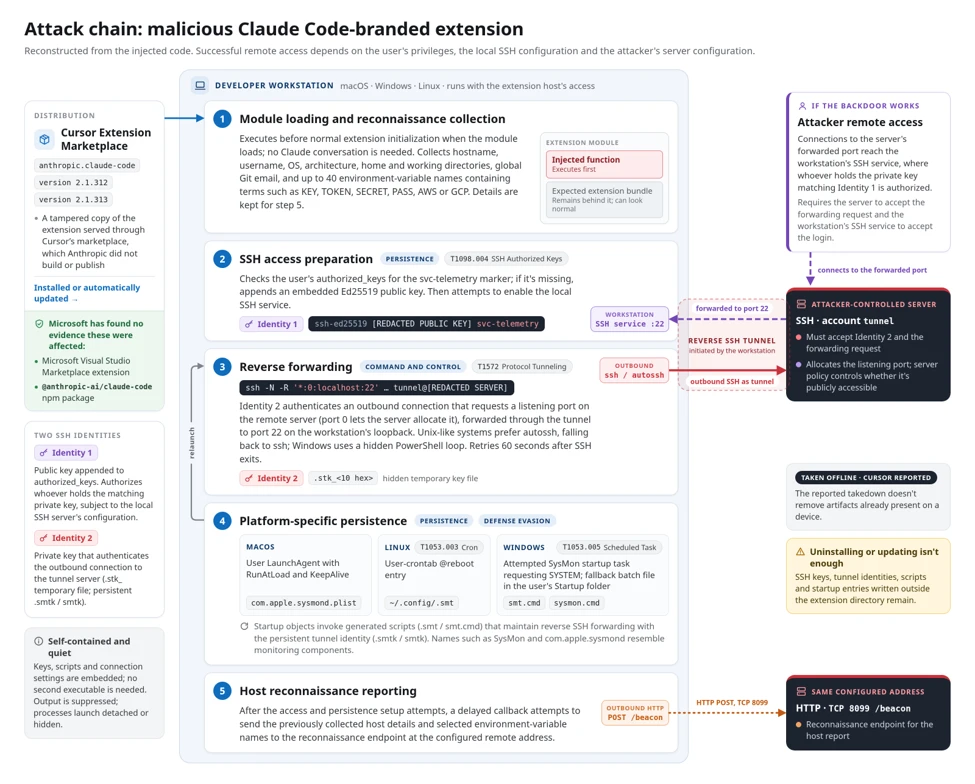
Microsoft’s October 30 investigation describes a malicious Claude Code-branded extension distributed through Cursor’s marketplace. The code attempted to add that key, prepare remote access, establish a reverse tunnel and install startup persistence. Whether access succeeded depended on the host and server configuration. A failed connection did not necessarily mean the workstation was unchanged.
That’s where the cases split. Microsoft says the affected packages were not distributed through its Visual Studio Marketplace or the official Claude Code npm package. Anthropic told Microsoft its systems were not compromised. The name on the package does not establish where every copy came from.
Not established: that every installation produced remote access, or that collected environment-variable names prove their values were taken. Microsoft’s analysis separates those names from their values. This rests on Microsoft’s published investigation, not an independent forensic examination.
A list of installed product names will not show which distribution path a machine used. Version records, installation history and endpoint evidence can separate a machine that received the package from one that only uses the same editor or assistant.
Removing the extension addresses the application package. Check what changed outside it, follow the vendor’s current remediation guidance, and tie each finding to a device with a reason it is considered resolved.
Which machines installed a package from Cursor’s marketplace, and which only share the product name?
What changed outside the extension: an SSH key, a reverse tunnel, startup persistence?
Which findings are tied to a specific device, and what marks each one resolved?
Source: Inside a malicious Claude Code-branded extension and its persistent SSH backdoor · 2026-10-30
Why it matters
An owner who checks only the product name will miss both the install path and any changes left outside the package.