

Analysis
The first move, in Microsoft's account, was a Teams message or a call from someone posing as IT.
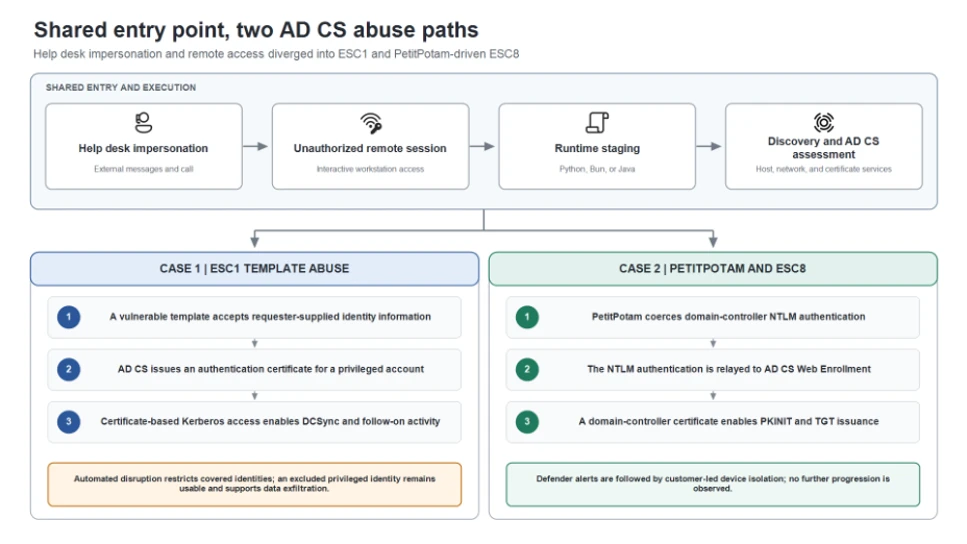
Microsoft Threat Intelligence described two human-operated intrusions on October 30. Both began that way. Teams messages and calls impersonating IT or help desk staff persuaded users to approve a remote session, mostly through Quick Assist. The attackers then staged portable Python, Bun or Java runtimes from user-writable folders and began assessing Active Directory Certificate Services.
At the certificate layer, Microsoft describes two different paths.
In the first, a template that let the requester supply identity information yielded certificates for privileged accounts, followed by DCSync. One privileged account had been excluded from automated containment. It was later used to copy data out with Rclone. An exclusion is an incident decision. It needs a compensating control, not quiet permanence.
In the second, the attacker coerced domain controller authentication with PetitPotam and relayed it to AD CS Web Enrollment, obtaining a domain controller certificate. Defender alerts led that customer to isolate the workstation. Microsoft observed no further progression.
Not established: who did it. Microsoft names no actor. This is Microsoft's account of two customer incidents, with no independent forensic review, and detection coverage depends on configuration.
Microsoft notes that revoking a certificate does not invalidate Kerberos tickets already issued.
Microsoft recommends verifying unsolicited support through a known channel and restricting external Teams access. It also says to review templates, remove unneeded enrollment rights and Web Enrollment endpoints, require HTTPS with Extended Protection, and audit issuance. Its hunting queries are starting points that need tuning.
Which templates accept a name the requester supplies? Where is Web Enrollment exposed? Which accounts are exempt from containment?
Source: From help desk impersonation to AD CS abuse: Investigating ESC1 and ESC8 intrusion paths · 2026-10-30
Why it matters
The Teams impersonation was shared; in our reading, not Microsoft's stated finding, the certificate configuration may have shaped how far each intrusion went.