
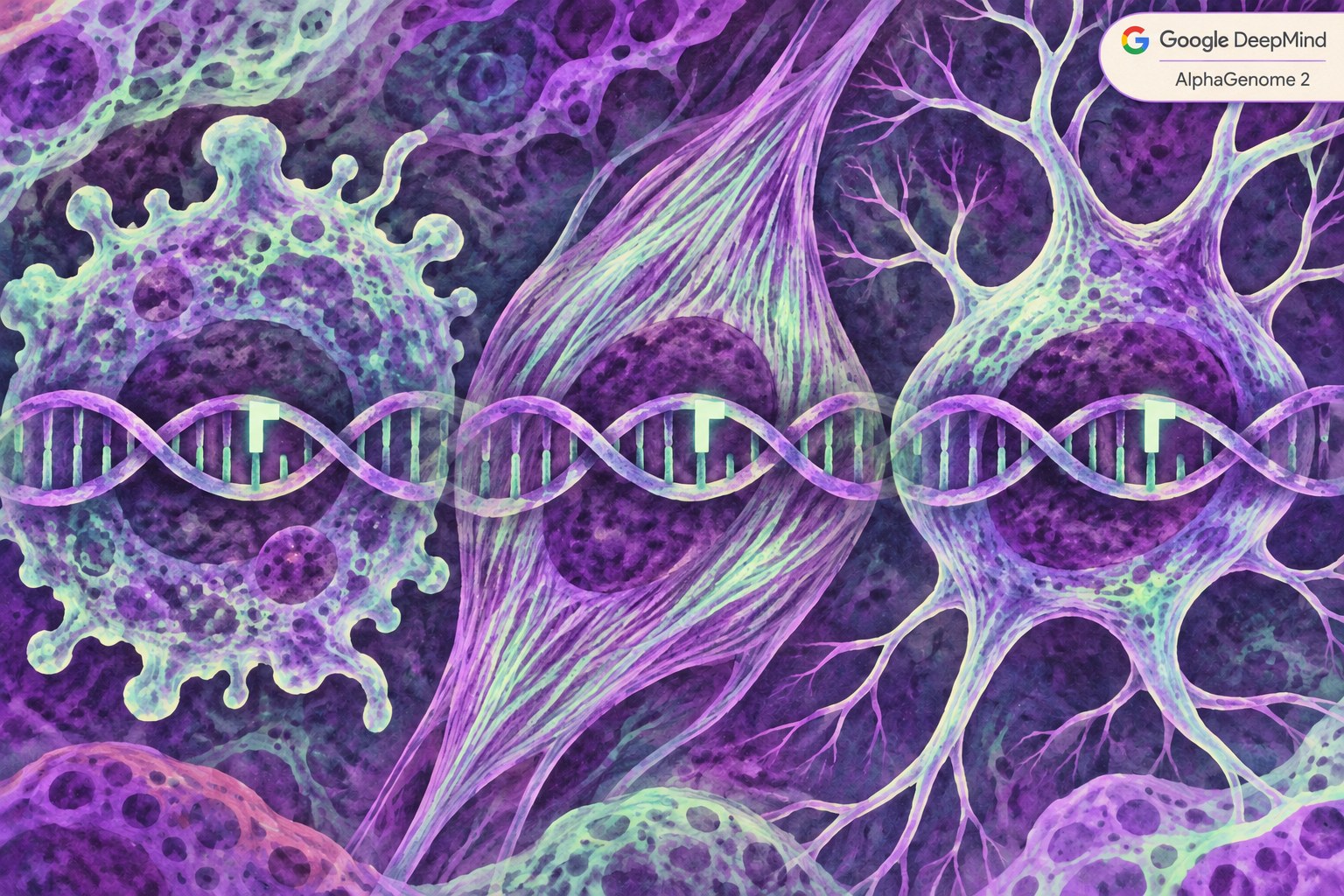
The question behind the model
Why would one change in a DNA sequence matter in a liver cell and do nothing in a neuron? Every cell carries the same genome, but each type reads a different part of it. Most of the sequence doesn't code for proteins; much of it helps decide which genes are switched on, where, and how strongly. So the effect of a single-letter variant can depend entirely on which cell you are asking about.
That is the question AlphaGenome 2 is built around, according to MarkTechPost's report of November 11. It describes the Google DeepMind release as a conditional DNA sequence model that predicts regulatory activity and variant effects per cell type. 'Conditional' is the idea worth holding on to: you give the model a sequence and a cell type, and it answers for that cell, instead of giving one averaged answer for all of them. The report says it is available through the AlphaGenome API for non-commercial use.
It is a lovely framing, because it matches the biology. Here is what it does not tell us. A prediction of regulatory activity is not a measured effect, and neither is a diagnosis. The summary the Journal read names no benchmark, no baseline, including the first AlphaGenome, and no laboratory validation. Cell types with plenty of training data will be better served than rare ones, and the report doesn't say which are which. API access also means researchers can query the model without being able to inspect it.
What I'm watching for
Predictions for cell types held out of training, checked against new experiments from a lab that didn't build the model. If the per-cell-type answers hold up there, this is a real step. If they hold up only where the data was already rich, it is a good map of what we knew.